If you've ever wondered whether Pilates can actually help you lose weight, the short answer is yes. Reformer-based Pilates builds lean muscle mass, improves metabolic efficiency, and reduces cortisol-driven fat storage, creating the same body-composition shifts associated with strength training without the joint stress of lifting heavy or running. In fact, a 2026 study published in Life revealed that regular Pilates practice directly lowers circulating cortisol levels, halting stress-induced fat retention while supporting healthy neuroendocrine function.
Reformer Pilates vs. Mat Pilates: A Different Impact on Body Composition
Both formats build core strength and improve posture, but reformer Pilates goes further when fat loss is the goal.
Mat Pilates relies on bodyweight only. It's effective for mobility, flexibility, and foundational core work, but the resistance ceiling is limited. Reformer Pilates adds variable spring tension, which means muscles are working concentrically and eccentrically under consistent load throughout every exercise. That sustained time-under-tension is the key driver of muscle hypertrophy and the metabolic boost that follows. A clinical trial published in Progress in Nutrition comparing 8 weeks of mat versus reformer Pilates demonstrated that participants using the reformer achieved significantly greater reductions in total body fat mass (−5.35%) and BMI (−1.87%) compared to mat-only groups.
In practical terms: reformer sessions activate more muscle groups simultaneously, produce greater post-exercise oxygen consumption (the "afterburn" effect), and generate a more favorable shift in lean-mass-to-fat ratio over time. This post-workout oxygen debt (EPOC) keeps your metabolism elevated for hours after class, adding an additional 6% to 15% in energy expenditure as your body recovers. Members who transition from mat-only to reformer-based training routinely report changes in body composition (tighter muscles, reduced body fat) even when the scale moves modestly.
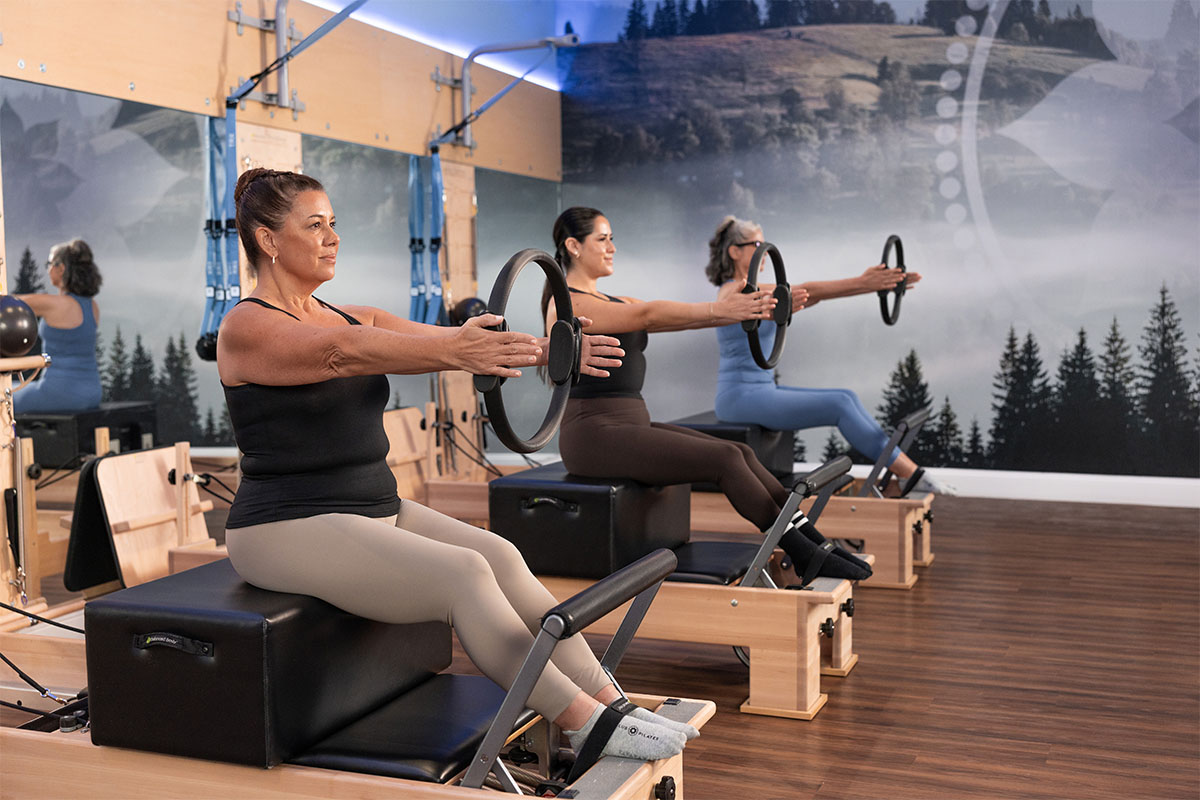
Traditional mat Pilates classes (offered at many general fitness studios) rely solely on bodyweight. Club Pilates classes are reformer-based, which means every session delivers the resistance-driven results that mat-only practice can't replicate.
Estimated Calorie Burn by Club Pilates Class Type
- Reformer Flow 1 / 1.5 (foundational reformer): 250–350 calories per 50-min session
- Reformer Flow 2 (intermediate reformer): 300–400 calories per 50-min session
- Cardio Sculpt 1.5 / 2 (high-intensity reformer + cardio intervals): 400–550 calories per 50-min session
- Suspend (TRX reformer hybrid): 320–420 calories per 50-min session
- Center & Balance (stability, reformer + props): 220–300 calories per 50-min session
For context: a traditional mat Pilates class (not offered at Club Pilates) burns approximately 180–250 calories per 50-min session for a 150 lb person. This aligns with the updated Compendium of Physical Activities, which rates mat Pilates at 1.8 to 2.8 METs, compared to the significantly higher energy cost demanded by variable spring-resistance reformer work.
Estimates based on a 150 lb person. Individual results vary.
Cardio Sculpt and Circuit sit at the top of the calorie-burn range because they incorporate higher heart rate zones alongside resistance work. If fat loss is the priority, rotating between Cardio Sculpt and Reformer Flow formats delivers both the metabolic and muscular stimulus required.
How Often Should You Attend to See Results?
To support healthy weight management, the American College of Sports Medicine (ACSM) recommends combining regular movement with resistance training. Three to five Club Pilates sessions per week fit right into those guidelines—building lean muscle, boosting your daily calorie burn, and setting the structural foundation for a balanced, active lifestyle. Pair 3 sessions a week with a balanced diet to start seeing improvements in strength and posture within 8 to 12 weeks, or step up to 5 sessions to accelerate your body composition goals.
Consistency matters more than intensity at the start. New members who commit to three classes per week and build gradually (adding Cardio Sculpt or Reformer Flow 2 sessions as their baseline fitness improves) tend to see the most noticeable results.
What Our Members Have Experienced
The best evidence isn't in a study. It's in the stories of people who showed up.
Wendi came to Club Pilates after 30 years of gym life left her burned out and struggling with her weight. After losing two family members and gaining significant weight, she signed up for her first reformer class at the Morgan Hill studio in 2018. She described being skeptical: lying on a reformer didn't look like a workout. Two days of soreness later, she was hooked. Since committing to Club Pilates, Wendi has lost over 60 pounds and credits reformer Pilates as the training method that finally worked when everything else had stopped.
A member at our Coppell, Texas studio came to Club Pilates at 32 after multiple surgeries (ACL reconstruction, rotator cuff repair, a hip labrum tear, and spinal disc issues) had sidelined her from the gym she loved. She started cautiously with Reformer Flow 1, then progressed to Suspend, Cardio Sculpt, and Reformer Flow 2. Within weeks her chronic pain had eased. By the time she hit 100 classes, she had lost more than 30 pounds, results she says she never thought she'd reach.
Both journeys look different on paper, but they share the same foundation: showing up consistently, trusting the method, and letting the reformer do its work.
Your first class is free. Find a Club Pilates studio near you and claim your complimentary intro class to take the first step toward a leaner, stronger body.